 Fix My Japanese
Japanese writing guide
How to Check Your Japanese Before You Send It
You have a Japanese message ready to send, but a particle looks wrong or the request feels too blunt. Start with what you want to say and who will read it. Then check the grammar and review any changes in tone separately.
Check your Japanese1. Pin down your meaning
Before changing the Japanese, write down the facts your message must preserve: who is doing what, when it happens, and what you need from the reader. A polished sentence can still say the wrong thing.
For example, 金曜日までに送ります means “I will send it by Friday.” 金曜日に送ります means “I will send it on Friday.” Both are grammatical, but they make different commitments. Check deadlines and names against your original message after accepting a correction.
2. Fix the grammar
Check each sentence's verb form, particles, and tense. Work through one change at a time so you can explain why it belongs there.
The examples below are written for this guide.
A message to a friend
You're arranging to see a movie tomorrow and offering to go and buy the tickets.
Draft
明日の映画、何時に待ち合わせする?チケットを買うに行くよ。
Grammar corrected
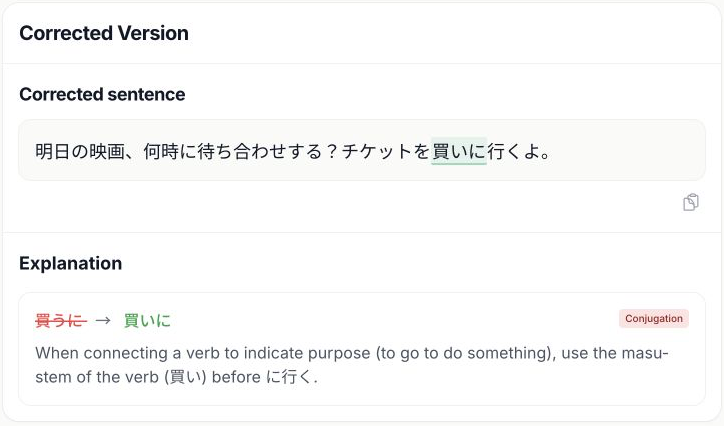
明日の映画、何時に待ち合わせする?チケットを買いに行くよ。
“What time should we meet for tomorrow's movie? I'll go and buy the tickets.”
The fix is 買うに行く to 買いに行く. To say you are going somewhere to do something, use the verb's ます-stem before に行く: 買います becomes 買い. The Japan Foundation's Irodori grammar worksheets have more examples of this pattern.
The question about meeting time already works. Keep it. Changing it to a more formal question would be a choice about your relationship with the friend, not a grammar fix.
3. Check how your request sounds
Once the grammar works, read the message as its recipient. Are you asking them for a favor, giving instructions, or confirming something they have already agreed to?
An email to a teacher
You can't attend next Tuesday's lesson and need the homework sent to you.
Draft
田中先生
来週の火曜日は用事があるですので、授業を休みます。宿題を送ってください。
Grammar corrected
田中先生
来週の火曜日は用事があるので、授業を休みます。宿題を送ってください。
“Tanaka-sensei, I have another commitment next Tuesday, so I'll miss class. Please send me the homework.”
あるですので needs correcting. Here, あるので connects the reason to the rest of the sentence. The plain form ある is fine in this clause even though the sentence ends politely with 休みます.
送ってください is grammatical. Changing it to 送っていただけますか (“Could you send it to me?”) makes the request less direct, which fits asking the teacher to do something for you. That is a tone edit. You don't need to replace every ください in your writing.
4. Review a work email
Check whose action each verb describes. Honorific language can show respect for the recipient's actions; humble language can describe your own actions toward them.
Sending a schedule to a client
You've spoken by phone and are sending the client the schedule you discussed.
Draft
山田様
お世話になっております。先ほどお電話で話した日程表を添付します。ご覧してください。
Grammar corrected
山田様
お世話になっております。先ほどお電話で話した日程表を添付します。ご覧ください。
“Dear Yamada-san, thank you for your continued support. I've attached the schedule we discussed on the phone earlier. Please take a look.”
The request form here is ご覧ください, from ご覧になる. Remove して. It is the client who will look at the schedule.
For a more formal ending, you could change 添付します to 添付いたします. This describes your own action more deferentially. The original 話した日程表 is grammatically valid: the plain past form modifies the noun 日程表. It doesn't need a ます ending there.
Choose the level that fits your correspondence. The Agency for Cultural Affairs' guidance on keigo and relationships explains why the situation and the people involved matter. Adding more formal language everywhere can make a simple exchange unnecessarily stiff.
5. Read it once more before sending
In Fix My Japanese, paste your draft, choose the tone you want, and press “Fix It!”.
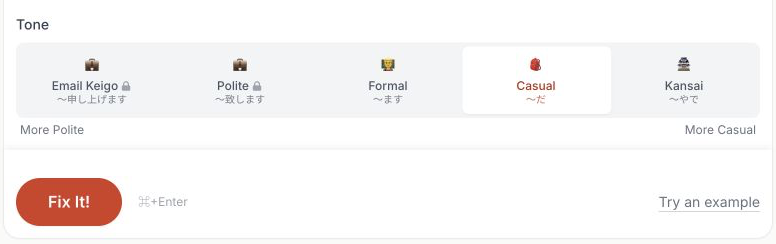
Read the explanation for each change alongside the corrected text. If a suggestion changes a deadline or makes a request stronger than you intended, revise it before sending.
- Are the names, dates, amounts, and attachments correct?
- Does the message still say who will do what?
- Can you explain the grammar changes you accepted?
- Does the level of politeness fit this reader and this request?
Read the whole message once, including the subject line. Open any attachment and check that it is the file you meant to send.
Check your Japanese